In short ⚡
Importer of record is the person or entity that customs officially recognizes as the importer for a shipment and holds legally responsible for the accuracy of the import declaration, payment of duties and taxes, and compliance with all import regulations. The importer of record provides the importer identification (tax ID/EORI/BN), approves the declared value and Incoterms context, validates HS classification and origin, controls the supporting documents (invoices, transport, origin and compliance certificates), and keeps records for post-clearance audits. It is not automatically the freight forwarder or customs broker; it can be the buyer’s own local entity, the customer/distributor, or a third‑party IOR service provider, depending on who is legally allowed and prepared to assume this liability in the destination country.We hope you’ll find this article genuinely useful, but remember, if you ever feel lost at any step, whether it’s finding a supplier, validating quality, managing international shipping or customs, DocShipper can handle it all for you!
Importer of record basics: definition, role, and when you need one
If you’ve ever had a shipment “mysteriously” parked at customs, you’ve already met the concept of an importer of record, even if nobody called it that.
Here’s the thing, customs doesn’t clear cargo for a vague idea like “the buyer” or “the supplier.” You need a legally accountable party, and that’s exactly what the importer of record (IOR) is.
You’ll notice fast that the IOR role isn’t a logistics detail. It’s a legal and tax responsibility tied to the import declaration, duties, product compliance, and post-clearance audits.
- Plain meaning: the IOR is the party customs can hold responsible if something is wrong.
- Operational meaning: the IOR controls the import entry data, supports it with documents, and accepts audit risk.
- Commercial meaning: the IOR decision affects Incoterms strategy, landed cost, and who “owns” customs mistakes.
From experience, the biggest frustration happens when your supplier says, “Don’t worry, we’ll handle customs,” then the shipment hits the border and the broker asks: “Who is the importer of record?”
That’s the moment most importers get stuck, because you can’t improvise the IOR at the last minute.
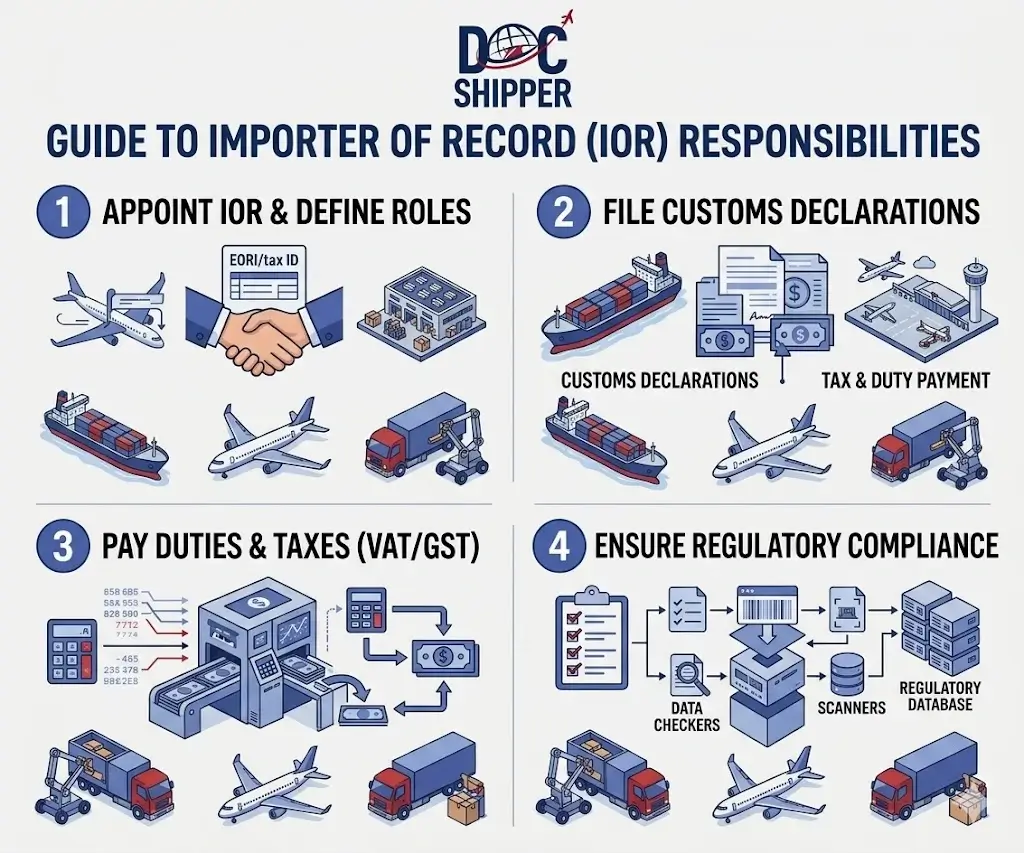
Quick workflow, how the IOR role shows up in a real import:
- Step 1: You choose who will act as the importer of record (your entity, your customer, or an IOR service provider like us at DocShipper).
- Step 2: You align Incoterms and the customs clearance plan with that decision.
- Step 3: You prepare entry data (HS code, value, origin, product requirements) and supporting documents.
- Step 4: The broker files the entry under the IOR’s name and number, duties and taxes get paid.
- Step 5: Records get stored for audit, and any post-clearance issues come back to the IOR.
IOR readiness checklist (use this before you ship):
- Do you have a clear, written decision on who is the importer of record?
- Is your customs broker authorized to file under that IOR?
- Do you have consistent HS classification and a defendable customs value?
- Are product compliance requirements known (labels, safety, certificates)?
- Can the IOR keep records and respond to a customs query after delivery?
DocShipper Alert
Secure your importer of record structure before shipping, we align registration, broker authority, and Incoterms to prevent last minute clearance blocks.
What “importer of record” means in plain language
An importer of record is the person or entity that customs recognizes as the official “importer” for a specific shipment, the one on the hook for the accuracy of the import declaration.
Not the forwarder. Not the warehouse. Not the factory, unless they’re formally acting as the IOR and legally allowed to do so.
Think of it like signing a high-stakes form where you’re stating, “This is what the goods are, this is what they’re worth, this is where they come from, and yes, they meet the rules.”
And if that statement is wrong, customs doesn’t chase your supplier’s sales rep, they chase the importer of record.
We’ve seen a classic scenario with a first-time importer buying “simple” electronics.
The supplier reused an old invoice template, the value looked inconsistent, and the broker filed anyway, then customs requested proof of payment and technical specs, and clearance froze for days.
In practice, the IOR typically:
- Provides the importer identification details (like tax ID or customs number).
- Approves the declared value and the Incoterm context that supports it.
- Validates the HS code strategy and any special measures (anti-dumping, controls).
- Owns the “audit trail” if customs challenges the entry later.
| Role | What they do | What they don’t do (common misconception) |
| Importer of Record (IOR) | Legally responsible for entry accuracy, compliance, duties and taxes, and recordkeeping. | They don’t automatically transport your cargo or book freight. |
| Customs broker | Files customs entries and communicates with customs based on data you provide/approve. | They don’t become the importer of record just because they file. |
| Freight forwarder | Manages shipping logistics, routing, booking, and documents for transport. | They don’t “own” import compliance unless contracted for an IOR service too. |
When an importer of record is required in different countries
You need an importer of record for basically every formal import, but the tricky part is who is allowed to be the IOR in each destination.
This is where you stop thinking “we’ll just put the buyer,” and start thinking “do we have the right registrations, presence, and compliance coverage?”
Customs authorities don’t all play by the same rules.
And yes, this is why a shipment can clear smoothly into one country, then get blocked in the next with the exact same supplier and paperwork.
We’ve handled cases where a US seller shipped to a Canadian customer under DDP, thinking it was “full service.”
The carrier asked for a Canadian IOR number at the last second, nobody had it, and storage charges started ticking immediately.
Country-by-country reality check (high level):
- United States: Your importer of record is typically the owner, purchaser, or a licensed customs broker acting under power of attorney, and you’ll often use an IRS/EIN for identification. CBP expects the IOR to back up classification, value, and admissibility requirements.
- Canada: You usually need a Canadian importer number (BN). Non-resident importing can be possible in certain setups, but you still need the right registrations and a clean compliance process with the Canada Border Services Agency.
- European Union: In many cases, the IOR must be established in the EU and have an EORI. If you’re not set up properly, you’ll rely on an EU-established entity or an IOR service solution.
One authority worth keeping on your radar is U.S. Customs and Border Protection (CBP), because their audits and enforcement approach often becomes the benchmark for how strictly you should manage import records and entry data, even outside the US.
Mini workflow, deciding if you can be your own IOR:
- Step 1: Confirm if your entity is eligible to act as importer of record in the destination (registration, establishment rules, importer number).
- Step 2: Confirm you can produce required compliance documents on demand (certificates, test reports, labeling evidence).
- Step 3: Validate your broker setup (power of attorney, authorizations, data ownership).
- Step 4: Decide between “self IOR” vs “IOR service provider,” based on risk, volume, and internal capability.
Decision checklist (fast):
- Do you have the right importer ID/EORI/BN to be the importer of record?
- Can you handle product compliance checks without guessing?
- Are you ready to respond to customs questions weeks later, not just on delivery day?
- Does your Incoterms choice match the IOR reality (and who pays duties/taxes)?
DocShipper Info
We verify your IOR eligibility country by country, registrations, EORI, BN, bonds, and broker setup, so your shipment clears smoothly the first time.
Key responsibilities of the importer of record that keep your cargo compliant
The importer of record isn’t just a name on a form, it’s the party responsible for keeping your cargo compliant from declaration to post-clearance.
If you’ve ever felt that customs rules are “flexible until they aren’t,” you’re not imagining it, enforcement often kicks in when something looks inconsistent.
What we see most often is a gap between purchasing and compliance.
You negotiate price and lead time, but the IOR has to defend HS codes, valuation logic, and product legality when the shipment is already at the border.
We once saw a buyer push a supplier for a discount right before shipment.
The supplier updated the invoice, but forgot to update the purchase order and payment trail, then customs questioned the declared value, and the IOR had to rebuild the story under pressure.
IOR compliance workflow (what “good” looks like):
- Step 1: Validate the product scope and compliance constraints before production ships.
- Step 2: Lock HS classification and confirm duty impact on landed cost.
- Step 3: Set a defendable valuation method aligned with Incoterms and transaction docs.
- Step 4: Prepare licenses, certificates, and technical files as needed.
- Step 5: File entry, pay duties/taxes, then store records for audits and post-clearance reviews.
IOR responsibility checklist (non-negotiables):
- HS codes are selected consistently and supported by product specs.
- Customs value is traceable to invoices, PO, and proof of payment.
- Country of origin rules are understood, not guessed.
- All required import permits and compliance documents are available before arrival.
- Records are stored and retrievable for the full legal retention period.
DocShipper Advice
Audit your HS codes, valuation logic, and permits before departure, we review your file to reduce audit and penalty exposure.
Core legal duties: classification, valuation, and duty payment
Your importer of record is accountable for three things that customs cares about immediately, what it is, what it’s worth, and who pays.
Get one wrong, and you’ll see exams, delays, reassessments, or penalties.
Classification (HS code): you’re not just picking a code, you’re choosing a duty rate, possible controls, and sometimes anti-dumping exposure.
We’ve seen “steel parts” declared broadly, then reclassified into a more specific category, duties jumped, and the IOR got billed retroactively.
Valuation: customs value isn’t “whatever is on the invoice.”
Discounts, assists (like molds), tooling, royalties, and freight elements can change the declared value depending on the rules and Incoterms.
Duties and taxes: the IOR makes sure payment happens correctly and on time.
Even if your contract says the supplier pays, customs will still pursue the importer of record listed on the entry if something goes unpaid.
- Classification proof: technical datasheets, composition, function, photos, catalogs.
- Valuation proof: PO, commercial invoice, payment records, contracts, and adjustments.
- Duty payment control: broker statements, deferment accounts, and reconciliation.
| Duty area | What customs expects from the importer of record | What typically triggers a problem |
| HS classification | Clear product description and consistent HS selection. | Vague invoices like “parts” or “accessories,” inconsistent codes across shipments. |
| Customs valuation | A traceable transaction value with documented adjustments. | Last-minute discounts, missing proof of payment, tooling not declared. |
| Duties and taxes | Correct payer, correct timing, correct amounts. | DDP misunderstandings, wrong importer number, broker filing without alignment. |
Looking for a Reliable Shipping & Sourcing Partner?


Documentation, licenses, and recordkeeping the IOR must control
The importer of record must control the documents that prove your declaration is true, and keep them ready for the day customs asks, not if, when.
This is the quiet part of importing that saves you when an audit letter lands in your inbox six months later.
We’ve seen a clean clearance turn into a mess because the supplier “couldn’t find” the original test report for a regulated product.
Customs didn’t care, they asked the IOR for evidence, and the IOR had to either produce it or face enforcement actions.
What the IOR typically needs to have under control:
- Commercial documents: commercial invoice, packing list, purchase order, proof of payment.
- Transport documents: bill of lading or airway bill, delivery notes, freight invoices when relevant to valuation.
- Origin documents: certificates of origin when required, supplier declarations, manufacturing statements for preference claims.
- Compliance documents: import permits, product certificates, test reports, labeling evidence, technical files.
- Brokerage trail: entry summaries, duty receipts, classification rulings, post-entry amendments.
Recordkeeping sounds boring until you get a query.
And yes, customs can ask for records long after delivery, which is why the IOR must be organized enough to respond fast and consistently.
One reference point you’ll hear in serious compliance teams is the World Customs Organization (WCO), because their frameworks influence how many administrations think about data quality, risk targeting, and post-clearance audit.
Micro workflow, document control that actually works:
- Step 1: Collect documents from the supplier before cargo departs, not after arrival.
- Step 2: Validate consistency across invoice, packing list, HS code logic, and Incoterms.
- Step 3: Confirm licenses and certificates match the product model, batch, and destination rules.
- Step 4: Share the approved pack with the broker for filing under the importer of record.
- Step 5: Archive everything in a structured folder system with shipment references for audits.
Document control checklist (save this):
- Invoice descriptions are specific enough to support the HS code.
- Values, quantities, and weights match across all documents.
- Any required permits or certificates are issued and valid before arrival.
- Proof of payment and contract terms are retrievable for valuation defense.
- All entry, amendment, and duty payment records are stored and searchable.
Who can be your importer of record and how to choose the right option
You have three main options for your importer of record, and each comes with different legal exposure, tax implications, and operational control. Choosing the wrong one can block your shipment or expose you to audits and penalties.
- Your own local entity in the destination country
- Your customer or distributor
- A third party IOR service provider
If you have a registered company with a valid tax ID, customs bond where required, and the ability to manage compliance, you can usually act as your own IOR. This is common in the US, Canada, and most EU countries when you have a physical or fiscal presence.
If you do not have a legal entity or tax registration in the importing country, you will typically need a licensed IOR service provider. In regulated sectors like medical devices, telecom, or defense, this becomes even more critical.
| Option | When it works | Main risks | Best for |
| Your own entity | You have local registration and compliance team | Full audit and penalty exposure | Established importers with recurring flows |
| Customer as IOR | Customer agrees contractually | Loss of control over clearance and timing | B2B sales with strong distributors |
| Third party IOR provider | No local entity, complex goods | Service cost, need strong contract | Market entry, project cargo, regulated products |
In the US, you need an IRS number or EIN and often a customs bond to act as IOR. In the EU, you need an EORI number and sometimes a fiscal representative if you are non resident.
Before choosing, use this operational checklist.
- Do you have a valid tax ID and customs registration in the destination country
- Can you legally import the product category under local regulations
- Can you post a customs bond or financial guarantee if required
- Do you have internal resources to manage audits and recordkeeping for 5 to 10 years
- Are you ready to assume liability for classification and valuation errors
If you hesitate on two or more points, you likely need a professional IOR solution. We regularly support clients who underestimated compliance exposure and faced blocked cargo at destination.
Your importer of record is not just a name on a form, it is the legal party customs will pursue in case of non compliance. You must treat this decision as a strategic one, not an administrative detail.
DocShipper Alert
Get a tailored IOR recommendation, based on your entity status, product risk, and destination regulations.
How the importer of record fits with Incoterms, brokers, and freight forwarders
Many importers confuse Incoterms with importer of record responsibility. They are not the same thing.
Incoterms define who pays for transport and insurance, but they do not automatically define who is the importer of record. Customs law prevails over commercial terms.
- Under DDP, the seller often acts as IOR, but only if legally registered in the destination country
- Under DAP or CPT, the buyer usually becomes IOR
- Under EXW or FOB, the overseas buyer typically acts as IOR at destination
| Role | Main Function | Legal Liability for Import |
| Importer of Record | Declares goods, pays duties, ensures compliance | Yes |
| Customs Broker | Submits entry on behalf of IOR | No, acts under IOR authority |
| Freight Forwarder | Organizes transport and logistics | No |
Your customs broker files entries in your name as IOR, but liability remains yours. If classification is wrong, customs will audit you, not the broker.
Your freight forwarder moves cargo, books space, and coordinates documents. They do not assume compliance responsibility unless contractually appointed as IOR.
Here is the simplified workflow you should understand before shipping.
- Confirm Incoterm in sales contract
- Appoint importer of record legally and contractually
- Prepare commercial invoice with correct HS code and valuation
- Provide power of attorney to customs broker
- File customs entry under IOR name and ID number
- Pay duties, VAT, and other taxes
- Maintain records for post clearance audit
When we manage end to end shipments at DocShipper, we align Incoterms, IOR structure, and customs brokerage from day one. This prevents last minute structural issues at port of arrival.
The biggest risk you face is assuming your forwarder “handles everything” while no compliant importer of record is legally appointed. That mistake alone can freeze high value cargo.
DocShipper Advice
We coordinate contracts, broker powers of attorney, and clearance strategy, so no one assumes liability by mistake at destination.
Conclusion
You cannot treat the importer of record as a formality. It is the legal backbone of your international shipment.
- The importer of record is legally responsible for compliance, duties, and recordkeeping
- You can act as your own IOR only if you have proper registration and compliance capacity
- Third party IOR providers are essential for market entry and regulated imports
- Incoterms do not automatically define who the IOR is
- Customs brokers and forwarders support operations but do not replace the IOR
- Proper structure prevents audits, delays, and financial penalties
If you are unsure who should act as your importer of record, we can assess your structure, country by country, and secure a compliant solution before your cargo ships. That decision, taken early, protects your entire supply chain.
FAQ | What an importer of record is and how it protects your global shipments
The importer of record (IOR) is the party customs holds accountable, not the forwarder or carrier. In practice, the IOR must:
- Ensure the goods are correctly classified with the right HS codes
- Confirm the customs value and who pays duties/taxes
- Make sure all import permits, certificates, and licenses are in place
- Authorize a customs broker to file entries on their behalf
- Keep records and respond to any customs queries or audits after clearance
- --
You typically need an external IOR service when:
- You don’t have a legal entity, tax ID, or importer number in the destination country
- You’re shipping regulated products (e.g. electronics, medical devices, telecom, defense)
- You want to sell under DDP or similar terms but cannot legally act as IOR
- You’re entering a new or “complex” market and lack internal compliance expertise
- You want to avoid exposing your own entity to local audits and penalties
A good IOR provider will:
- Act as the legal importer, under their own registrations
- Manage documentation, licenses, and compliance checks
- Coordinate with customs brokers and your forwarder to keep cargo moving
- --
Yes, but fragmentation often increases risk and delay. If you split roles:
- Make sure each party clearly understands who is the IOR and who is only a service provider
- Align Incoterms, declarations, and invoices so all data is consistent
- Use written SOPs (standard operating procedures) between the IOR, broker, and forwarder
To reduce issues:
- Prefer one lead provider that coordinates IOR, brokerage, and logistics where possible
- If you must work with several vendors, assign one internal “owner” who controls the data and approvals
- --
You generally need a local registration and importer identification:
- United States: IRS number or EIN, plus a customs bond in many cases
- Canada: Canadian Business Number (BN) and importer account
- European Union: EORI number, and in some cases a fiscal representative if you are non‑resident
Beyond registration, you must be able to:
- Classify products consistently with defensible HS codes
- Determine correct customs values and keep proof (POs, invoices, payments)
- Manage licenses and product compliance under local rules
- Store records and handle audits for years after import
- --
Compare each option on control, risk, and capability:
- Your own entity as IOR
- Works if you’re registered locally and have compliance resources
- You keep maximum control but also take full audit and penalty risk
- Customer/distributor as IOR
- Works when the customer agrees in writing to act as importer
- You transfer legal risk but lose visibility and control over clearance timing
- Third‑party IOR provider
- Best when you lack a local entity or import complex/regulated goods
- You pay a service fee but get a structured, compliant import setup
If you’re unsure or weak on risk/compliance in a given country, a specialized IOR provider is usually the safer option.
- --
Customs will not clear the goods, and you can face:
- Storage and demurrage charges while parties argue over who can be IOR
- Last‑minute scrambling for registrations or an emergency IOR solution
- Delays that damage customer relationships and project timelines
- In extreme cases, return to origin or seizure if compliance is impossible
To avoid this:
- Decide and document who the IOR is before booking shipment
- Verify that this party is legally eligible to act as IOR in that country
- Align the sales contract, Incoterms, and customs broker instructions with that decision
Need Help with
Logistics or Sourcing ?
First, we secure the right products from the right suppliers at the right price by managing the sourcing process from start to finish. Then, we simplify your shipping experience - from pickup to final delivery - ensuring any product, anywhere, is delivered at highly competitive prices.


Fill the Form
Prefer email? Send us your inquiry, and we’ll get back to you as soon as possible.
Contact us